
Sovereign AI Is No Longer Just About Data Residency: Who Controls the Compute?
Sovereign AI concerns the ability to govern an AI system’s data, models, compute and operations—not simply the country in which a database sits. An organization must understand who can allocate capacity, access model artifacts, change software and interrupt service. Local hosting can help meet locality requirements, but effective authority depends on architecture, contracts and operational capability.
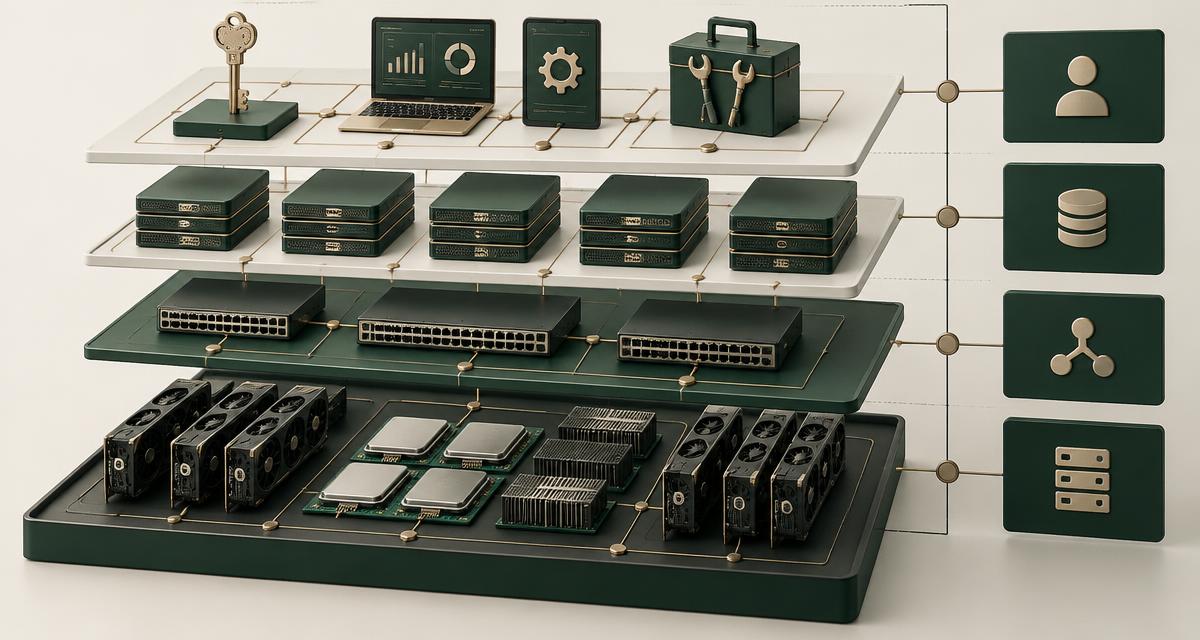
Conceptual editorial illustration; not a product interface or measurement result.
What changed in 2026? AI governance reaches the operating stack
Saudi NCA opened consultation on its AI Cybersecurity Guidelines on July 5, 2026, with an August 5 deadline. The AICG-1:2026 document located for this article is explicitly a draft. Its scope includes governance, defense, resilience and third-party cybersecurity, including generative and agentic AI. Do not mistake consultation material for verified final binding controls.
The engineering consequence is broader than model selection. A useful governance review now traces training data, inference inputs, retrieved documents, agents, credentials, logs and recovery processes. Each can sit under a different operator. Residency is still important, but a residency statement cannot answer who controls an administrator account or a capacity reservation.
The OECD’s Securing AI compute report, published October 13, 2026, examines capacity, skills, access and resilience as distinct policy objectives. Its discussion includes location, ownership and supply-chain security. That supports a layered evaluation; it does not certify any individual provider as sovereign.
This article uses sovereignty as a decision framework, not a product certification. Requirements differ by sector, data classification and contract. A compliance team must identify the rules that actually apply; infrastructure teams then demonstrate that their system and procedures satisfy those requirements.
Start with the complete data path
Draw the route from a user request to the final answer. Include API gateways, model endpoints, document retrieval, embedding services, vector stores, caches, telemetry and support access. A locally stored source document may be transmitted to another processing location during inference. Conversely, an external model service may offer a regional processing configuration, which must be verified rather than assumed.
Classify prompts, responses, retrieved passages, embeddings and operational logs separately. They can contain personal or commercially sensitive information even when the original document never leaves a local repository. Record retention, deletion, encryption and allowed support access for every copy.
Anonymization and filtering can reduce exposure, but they need tests against realistic documents. Redacting an obvious name does not necessarily remove identifying context. Keep a data-flow register linked to deployment configurations so an architecture diagram is not disconnected from the system actually running.
Compute sovereignty is about usable authority, not hardware ownership alone
Owning servers does not necessarily mean controlling the processing service. Firmware, GPU drivers, runtime libraries, orchestration and remote management may introduce dependencies on outside suppliers. Ask which functions stop if connectivity, entitlement updates or a supplier service become unavailable, and which can be restored by your own team.
For GPUs, specify memory capacity, supported precision, interconnect and the workload’s real concurrency needs. A large accelerator count does not establish suitable inference performance. Dedicated capacity may be valuable for predictable service, while elastic external capacity may be valuable for training bursts. Either model requires verified provisioning and failure behavior.
Separate the right to reserve resources from the ability to operate them. A contract might guarantee capacity while the provider controls scheduling and maintenance. That can be acceptable, but the responsibility boundary should be explicit. Strong governance can be achieved with a managed operator when its access, obligations and exit arrangements are suitable.
A control-layer assessment matrix
For each layer, name an accountable owner and request evidence. A list of desirable controls is not a substitute for demonstrating them.
| Layer | Question | Evidence to request |
|---|---|---|
| Data | Where does each copy get processed and retained? | Data-flow map, region configuration and deletion tests |
| Models | Can weights, licenses and versions be retained or changed? | Model license, artifact registry and version history |
| Compute and network | Who allocates capacity and changes connectivity? | Reservation terms, admin roles and failure tests |
| Identity and operations | Who can access, update or stop the system? | Privilege records, audit logs and patch procedures |
| Portability | Can the workload be rebuilt elsewhere? | Export formats, recovery rehearsal and dependency inventory |
Models, identity and update paths create separate dependencies
Access to model weights is not the same as the right to modify or redistribute them. Check model licenses, acceptable-use obligations and downstream dependencies. Keep approved artifacts, hashes and version records, and define how a vulnerable model runtime or unsafe model behavior triggers a change.
Agentic workflows add privileged tools to this picture. A model that can call a database or deploy infrastructure needs narrowly scoped credentials and approval boundaries. Its activity should be attributable and auditable; giving a general-purpose assistant administrator rights is not made safe by local hosting.
Review the update path from firmware through the model-serving application. Decide which updates can be tested and staged locally, how authenticity is checked and how rollback works. A disconnected design also needs a controlled method for obtaining patches and security advisories; isolation does not eliminate maintenance.
Portability and skills determine whether an exit is real
A portable VM image preserves only part of an AI application. You may also need model weights, tokenizer versions, retrieval indexes, prompt configurations, orchestration definitions, secrets and reproducible dependencies. Document which items are exportable, which require rebuilding and which are tied to proprietary services.
Test a small relocation before describing the architecture as portable. Rebuild the service, restore its data and run the same quality, latency and security tests. The ability to download an artifact is weaker evidence than a working service in another environment.
Operational skills are another dependency. Who can investigate poor model quality, GPU memory exhaustion, retrieval leakage or a failed upgrade? A local facility without available skills may still depend entirely on a remote operator. The private cloud strategy guide helps connect architecture ownership with a sustainable service model.
What this means for Saudi organizations
Translate policy language into a short set of workload requirements: approved processing locations, operator-access restrictions, key ownership, resilience targets and exit expectations. Then check the complete AI workflow against those requirements. Avoid treating all datasets or all AI uses as equally sensitive.
Saudi infrastructure discussions should include telecom dependencies and the operating team’s language, escalation coverage and authority during incidents. The Saudi cloud infrastructure trends guide supplies broader context. None of these considerations alone confers regulatory certification.
A practical procurement exercise asks both an internal platform team and a managed provider to demonstrate the same controls. Score evidence, not slogans. A private or public deployment may satisfy the intended boundary; neither inherits sovereignty from its label. Sovereignty also does not mean every AI workload must run privately: placement depends on data sensitivity, compute demand, operating model, economics and governance, which private AI vs public AI cloud examines per workload.
Where VirtuWa fits today—and what remains roadmap
VirtuWa’s current positioning is server virtualization and private cloud: Asas HV by VirtuWa as the KVM-based foundation, Lejam Cloud Manager by VirtuWa for centralized management, migration and backup/DR. These can support an infrastructure operating model, but they are not evidence of a released GPUaaS service or a complete AI model-serving stack. GPU-ready infrastructure remains roadmap direction.
For a commercial view of that direction, see sovereign AI infrastructure with VirtuWa. Validate any required accelerator, driver, runtime and orchestration support independently before specifying an AI deployment. Mehad should be understood as deployment and installer capability, with the released Terraform Provider presented separately.
For the foundations underneath, virtualization vs private cloud explains why virtualization technology alone does not constitute a cloud service.
Sources and references
Frequently asked questions
Is data residency enough for sovereign AI?
No. It establishes a location boundary, while sovereignty also concerns processing access, capacity, models, identity, updates and operational authority.
Must an organization own every server?
Not necessarily. A managed arrangement can meet defined requirements if access, contractual responsibilities, service continuity and exit rights are demonstrable.
Does an open model remove supplier dependency?
No. Check the license and dependencies on accelerators, runtimes, tooling, skills and update services. Model access is only one layer.
Are the cited NCA AI guidelines final?
The source verified for this article is the 2026 consultation draft. Do not treat it as a verified final mandatory standard without checking a later official publication.
Does VirtuWa currently offer production GPUaaS?
This article makes no such claim. GPU-ready infrastructure is roadmap direction; current platform evaluation must use verified released capabilities.
Explore Sovereign Infrastructure
Discuss your workload requirements and evaluation criteria with the VirtuWa team.
Explore Sovereign InfrastructurePrivate AI vs Public AI Cloud: Where Should Enterprise AI Workloads Run?
Compare private and public AI for enterprise data, models, capacity, cost and skills. Choose workload placement without assuming one model fits every service.
Read articleBuilding a private cloud strategy around control
How to define a private cloud operating model across workloads, governance, automation, resilience and lifecycle economics.
Read article