
Why Private Cloud Is Coming Back in the AI Era
AI changes the workload-placement equation: steady inference, enterprise data integration, dedicated capacity and latency requirements can make private cloud worth re-evaluating. Public cloud remains valuable for experimentation, elastic resources and managed services. The choice should follow the workload’s full data path and operating economics, and many enterprises will need a hybrid portfolio rather than a single default.
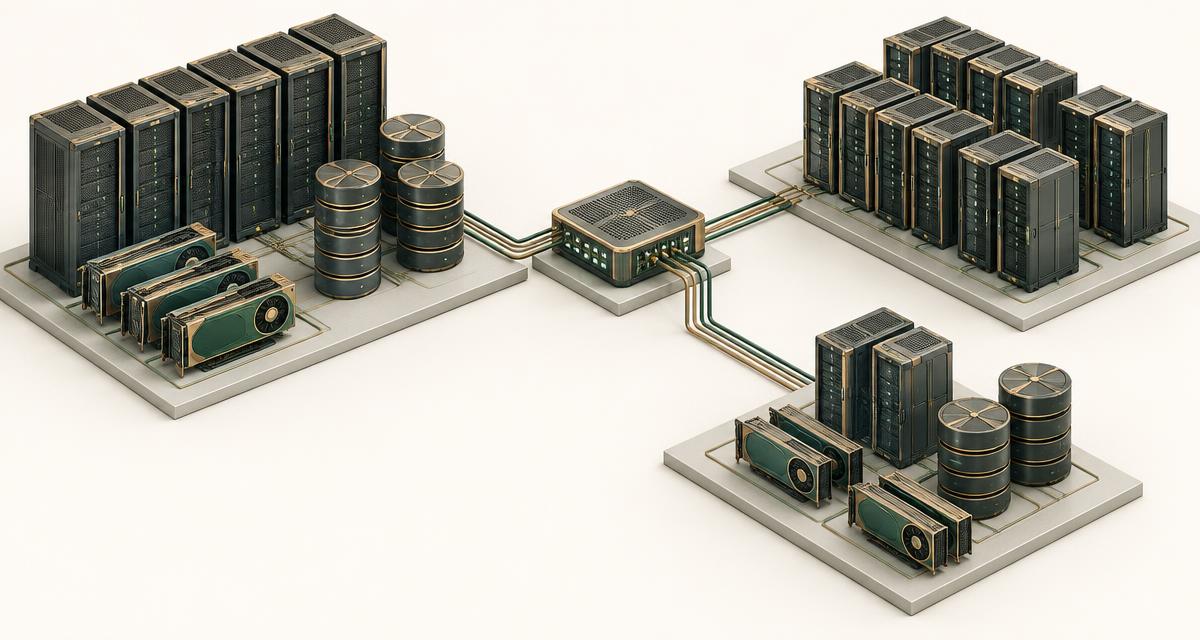
Conceptual editorial illustration; not a product interface or measurement result.
What changed in 2026? AI adds new placement questions
The headline describes renewed relevance, not a measured market-wide migration back on premises. This article does not claim that public cloud failed or that private cloud has universally overtaken it. AI adds capacity, data-access and serving requirements to an existing portfolio of VMs, databases and business applications.
Microsoft’s AI infrastructure guidance treats control, custom models and specialized performance as reasons to consider infrastructure choices, while recognizing the investment required. Saudi NCA’s 2026 AI guidance consultation adds a governance context; the verified document is a draft, not proof of final mandatory AI controls.
The useful question is which operating model fits each application now. A prototype that calls a hosted model and a continuously used private inference service are different workloads. They should not share a placement decision simply because both are called AI.
Long-running workloads change the utilization calculation
Traditional VM services remain part of the decision. Authentication, databases, integration services and enterprise applications may run continuously with predictable demand. Private capacity can serve these alongside new services when the hardware, isolation and support model are suitable. Existing assets are an input, not a reason to keep an obsolete design.
For inference, measure request volume, input and output sizes, model memory, concurrency and expected response time. A steady, well-sized service can use dedicated capacity effectively. A sporadic workload may leave expensive accelerators idle. Training bursts and inference services should be modeled separately because their schedules and bottlenecks differ.
Calculate effective utilization after maintenance and failure reserve. Allocating all resources to normal demand leaves no safe headroom when a host fails. Conversely, buying for a distant peak may create years of underuse. Public capacity or a second site can sometimes supply the variable part of demand.
Enterprise data and locality can dominate the architecture
A retrieval-augmented AI service may repeatedly access local documents, databases and authorization systems. Moving only model inference elsewhere can introduce network delay, data-transfer obligations and a new identity boundary. Compare the whole request path, not just the cost of compute at either end.
Private cloud can place processing close to enterprise data and give the organization direct responsibility for access and change. That responsibility has a cost: classification, keys, patching, segmentation and recovery do not disappear. Public cloud may offer suitable regional configurations and strong managed controls, but verify the chosen service rather than relying on a general region label.
Locality also affects outages. A local service can remain available during some external connectivity failures only if its identity, license, model, telemetry and operational dependencies can function without that connection. Test the actual dependency chain before promising disconnected operation.
Private, public and hybrid: a placement framework
Compare fit against a defined service target. These are tendencies to test, not automatic guarantees.
| Model | Potential strengths | Main operating trade-off |
|---|---|---|
| Private cloud | Dedicated capacity, local integration and direct infrastructure authority | Procurement, lifecycle work and capacity planning remain yours |
| Public cloud | Rapid access, elastic resources and managed AI services | Service-specific locality, quotas, dependencies and consumption cost |
| Hybrid cloud | Stable local services plus external experiments or bursts | Identity, data movement and two operating boundaries |
Latency and resilience need application-level tests
A short network round trip is helpful but not sufficient. Time can be spent in retrieval, queueing, storage, model execution and response streaming. Instrument those stages independently. For an interactive assistant, time to first useful response and tail latency can matter more than average network ping.
Separate infrastructure HA from service continuity. Restarting a VM on another host does not necessarily restore GPU state, a model cache or an in-flight job. Test how the application handles interrupted work. The HA, DRS and live migration guide explains why these capabilities serve different purposes.
Backups must include the assets needed to rebuild the service: model artifacts, configuration, retrieval data and access policies. Restoring VM disks alone may leave the system unusable. Define recovery-point and recovery-time objectives against the business service, then demonstrate them in a failure exercise.
Economics: compare the service, not the hourly compute price
Use the architecture and dependency approach in Microsoft’s total-cost planning guidance. A private estimate should include hardware, networking, power, facilities, licenses, operations, recovery capacity and refresh. A public estimate should include compute, storage, managed services, transfer, commitments and the people operating it.
Include demand uncertainty. Test a low-utilization private case and a high-consumption public case. Factor in model changes: an efficient smaller model may alter capacity needs, while a larger context window may increase memory pressure. Neither cloud label implies a fixed cost trajectory.
Do not treat public cloud commitments as perfectly elastic or purchased hardware as free after installation. Both can create economic commitments. Measure cost per accepted business transaction or useful answer, with quality and reliability held constant, rather than declaring a winner from unlike machine prices.
What this means for Saudi organizations
Start with data classification, sector requirements, approved operators and connectivity from the actual user locations. A private facility or local cloud region can be appropriate, but locality alone does not establish compliance. Clarify administrative access, contract responsibilities, incident handling and recovery-site arrangements.
Saudi organizations may operate across several cities and existing facilities. Placing every service near headquarters may not serve branch users or dependent applications well. A placement exercise should examine the routes between users, databases, processing and external APIs—not just a map pin.
AI changes workload placement, but it does not change private-cloud design fundamentals: operating model, governance, automation, lifecycle and resilience still decide success. The private cloud strategy guide covers those fundamentals; this article adds AI-specific utilization and data-path considerations. The server virtualization guide and KVM guide explain the VM foundation, while virtualization vs private cloud separates resource abstraction from a service model.
A bounded role for VirtuWa
VirtuWa offers a platform to evaluate for server virtualization, centralized management, migration and backup/DR. Asas HV by VirtuWa is KVM-based; GPU-ready infrastructure remains roadmap direction. Do not infer current production accelerator support or a managed AI service from private-cloud positioning.
Keep the evaluation bounded: select representative VM workloads, prove management and recovery, and record which future AI requirements need separate validation. Mehad is a deployment/installer capability, with the released Terraform Provider distinct from it. A usable foundation still needs an application and AI-serving stack.
Continue to sovereign AI and compute control for the authority boundaries behind placement. Compare deployment requirements in private AI vs public AI cloud. The decision is not whether private cloud is fashionable again; it is whether your chosen workload can be served reliably and economically under the required governance.
Sources and references
Frequently asked questions
Does AI mean public cloud is the wrong choice?
No. Public services can be well suited to experiments, variable demand and managed capabilities. Placement should follow workload requirements.
Is private cloud always cheaper for inference?
No. Economics depend on utilization, model size, capacity reserve, operations, power, support and the alternative service configuration.
Do all AI applications require GPUs?
No. Hardware needs depend on the model and workload. CPU execution may fit some services; validate quality, throughput and latency before selecting accelerators.
Can private and public services be combined?
Yes. A hybrid design can keep selected data and steady services local while using external resources, provided identity, transfer and failure boundaries are controlled.
What must an AI recovery test restore?
Restore model artifacts, configuration, retrieval data and access policies, then verify the application against its recovery objectives.
Explore Private Cloud with VirtuWa
Discuss your workload requirements and evaluation criteria with the VirtuWa team.
Explore Private Cloud with VirtuWaSovereign AI Is No Longer Just About Data Residency: Who Controls the Compute?
Sovereign AI goes beyond data residency. Assess compute, models, identity, operations and supplier dependencies for enterprise AI infrastructure in Saudi Arabia.
Read articlePrivate AI vs Public AI Cloud: Where Should Enterprise AI Workloads Run?
Compare private and public AI for enterprise data, models, capacity, cost and skills. Choose workload placement without assuming one model fits every service.
Read article